Bagru Print vs Ajrakh Print: How to Tell Them Apart
Put a Bagru print and an Ajrakh print side by side and most people see two versions of the same thing: wooden blocks, natural dyes, hand-printed cotton. Look a little longer and they could not be less alike.
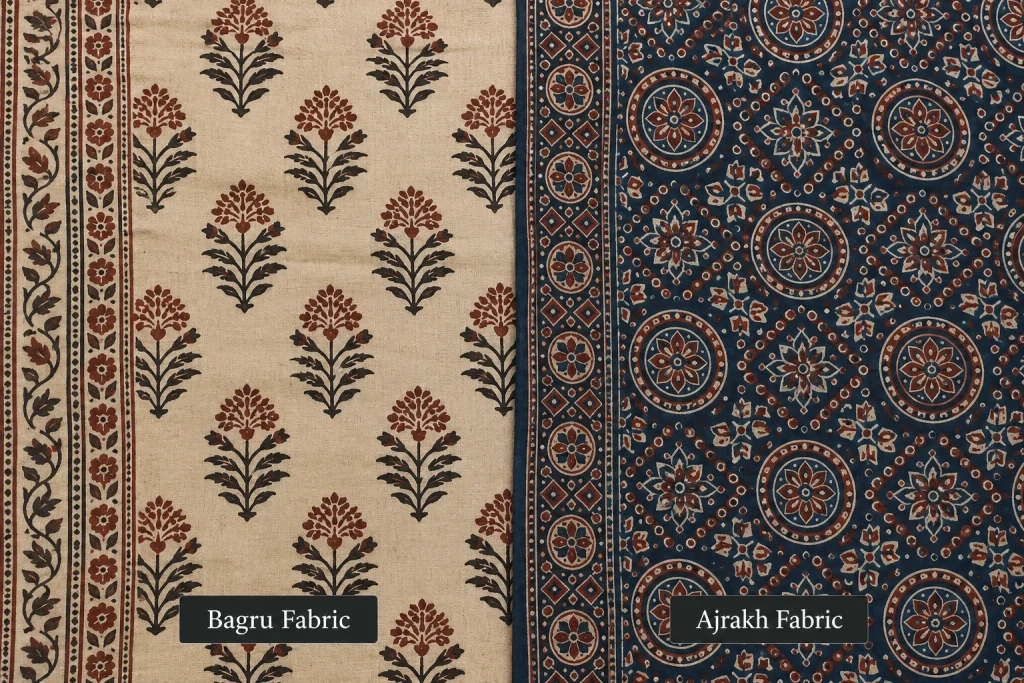
One is built on a pale, earthy ground and carries flowers, birds and vines. The other is dense, dark, geometric, and printed on both sides of the cloth. They come from different regions, different communities, and different ideas about what printed fabric is for.
We print Bagru ourselves, in Bagru, and we stock Ajrakh printed sarees from Kutch artisans. This is an honest comparison of the two — where each comes from, how each is made, how to tell them apart in your hand, and which one suits what you are shopping for.
The Short Answer
| Bagru Print | Ajrakh Print | |
|---|---|---|
| Origin | Bagru village, Rajasthan, about 30 km from Jaipur | Sindh region; today Kutch in Gujarat and Barmer in Rajasthan |
| Community | Chippa printers | Khatri printers |
| Ground colour | Cream or beige, from a harda treatment | Deep indigo and madder red |
| Motifs | Floral buti, bel vines, jaal lattice, birds | Geometric stars, interlocking medallions, fine borders |
| Printed on | One side | Both sides, aligned |
| Stages | Several | Can run to sixteen or more |
| Overall feel | Light, rustic, everyday | Dense, formal, architectural |
What Is Bagru Print?
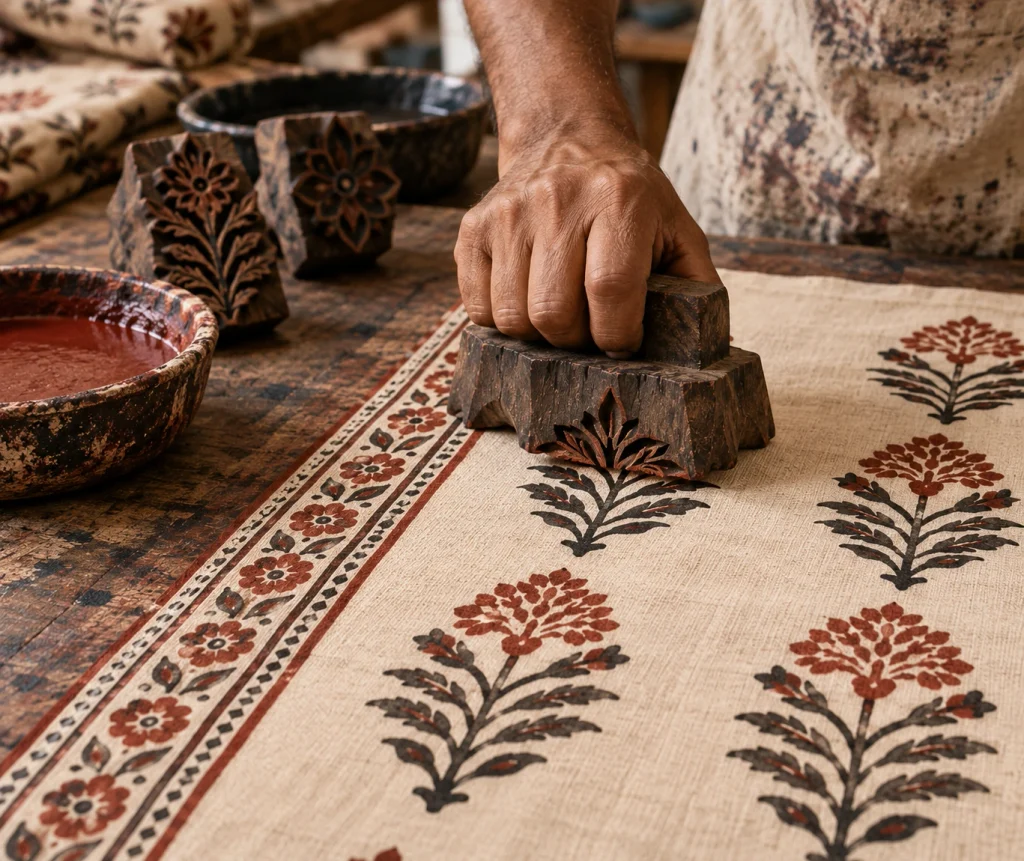
Bagru is a village roughly thirty kilometres from Jaipur, and Bagru hand block print takes its name from the place. The craft is practised by the Chippa community, who are said to have migrated from Sawai Madhopur and settled there generations ago. The word chippa comes from the act of stamping — a chippa is, literally, someone who prints.
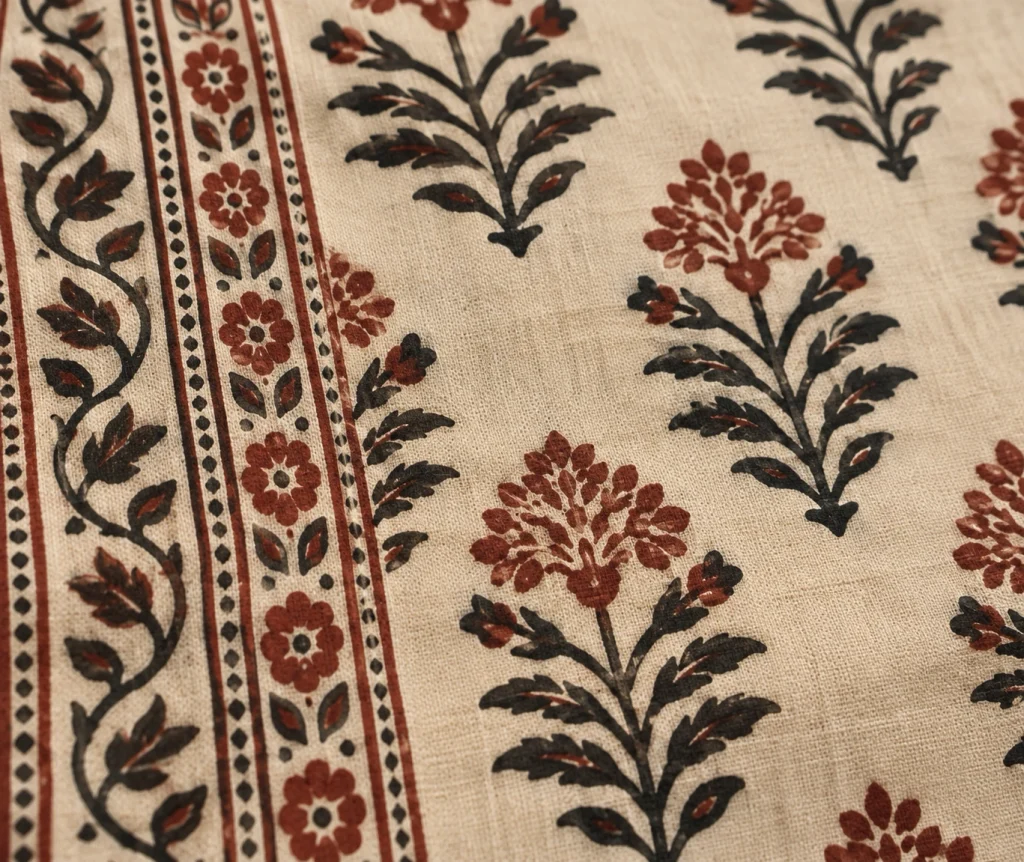
What makes Bagru recognisable is the ground the design sits on. Before any block touches the cloth, the fabric is treated with harda, a myrobalan preparation that turns it a soft cream or beige. That warm ground is why a traditional Bagru print never looks stark. Black comes from a fermented iron solution, red from alum-based mordants, and indigo from the vat.
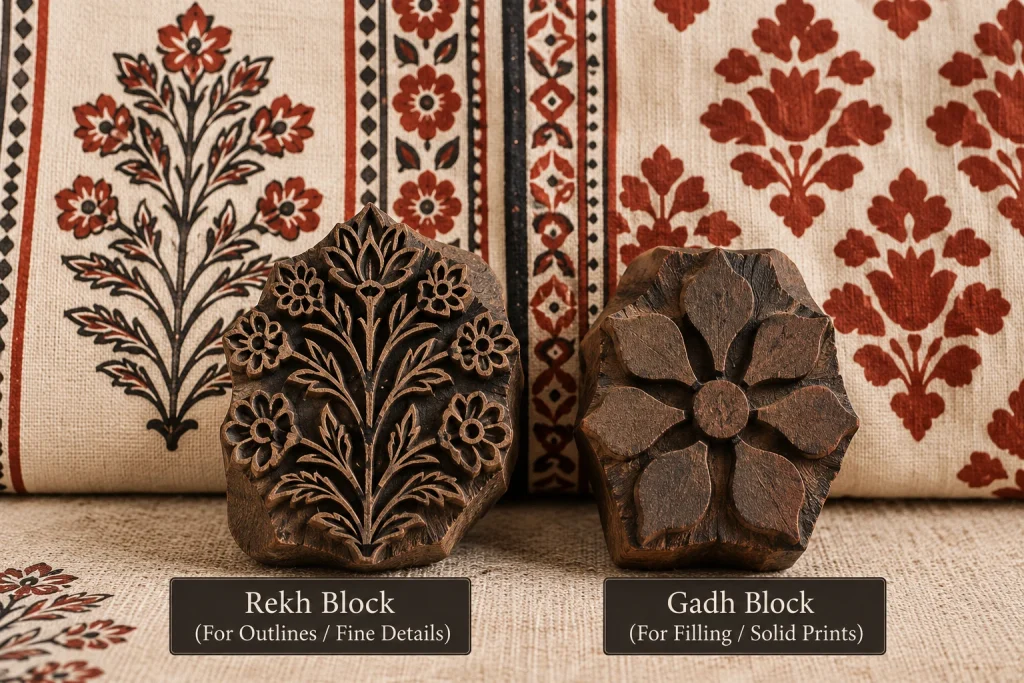
The motifs are drawn from the world immediately around the printer: floral buti, trailing bel vines, jaal lattice, birds, and simple geometric repeats. Blocks are carved by craftsmen known as kharaudi, usually in pairs — an outline block called rekh and a filling block called gadh.
Bagru also encompasses Dabu, a mud-resist technique in which a clay paste is block-printed onto the cloth so those areas resist the dye. Dabu is a Bagru-area speciality, and it produces the soft, slightly veined patterns you see on indigo pieces.
What Is Ajrakh Print?
Ajrakh printing comes from the Sindh region and is practised today mainly in Kutch, Gujarat, and Barmer in Rajasthan, by the Khatri community. The name is usually traced either to the Arabic azrak, meaning blue, or to the Sanskrit a-jharat, meaning that which does not fade.
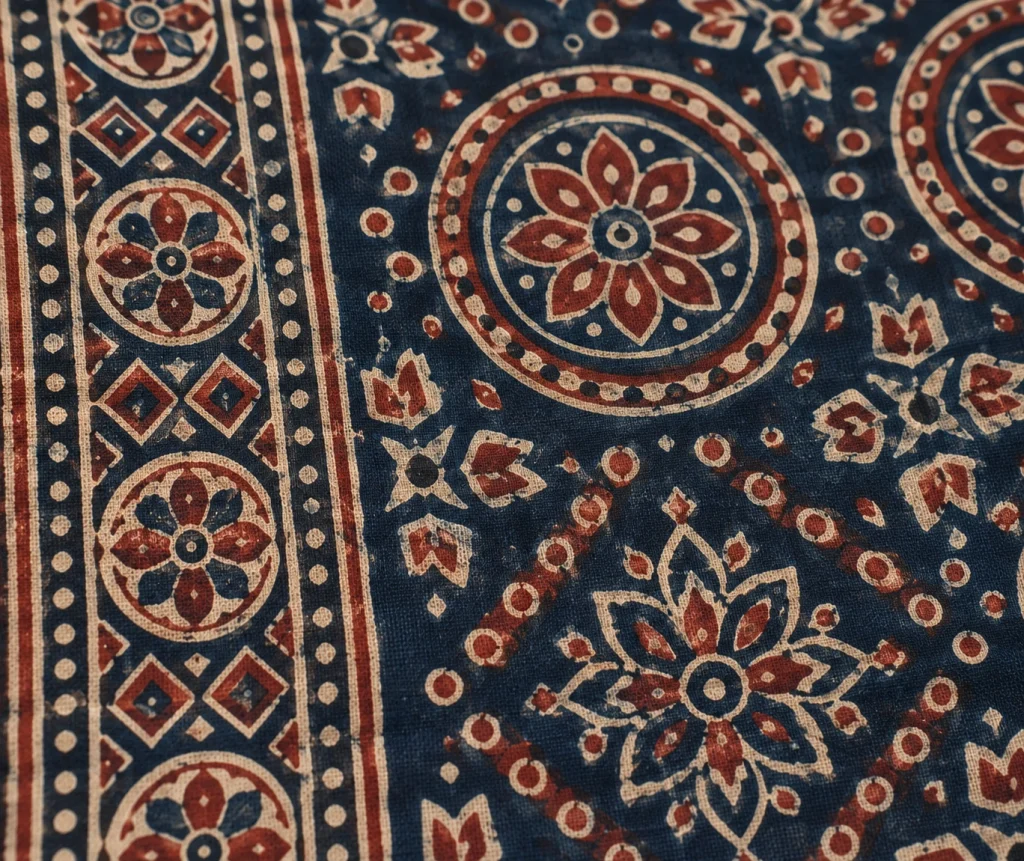
Ajrakh hand block print is defined by its process rather than its motifs. The cloth is washed, treated, resist-printed, mordanted, dyed, sun-dried, and re-treated — a sequence that can run through sixteen or more stages before the final pattern appears. Indigo and madder red do most of the work, with natural black and undyed white holding the composition together.
The most distinctive feature is that traditional Ajrakh is printed on both sides of the fabric, with the two faces aligned so the pattern reads identically front and back. That doubles the work and leaves no room for error in registration.
An Ajrakh block print is precise in its geometry: eight-pointed stars, interlocking medallions, dense borders, patterns that repeat with almost architectural discipline. Where Bagru looks at flowers, Ajrakh looks at symmetry.
How to Tell Them Apart in Your Hand
Five checks, in order of how quickly they work.
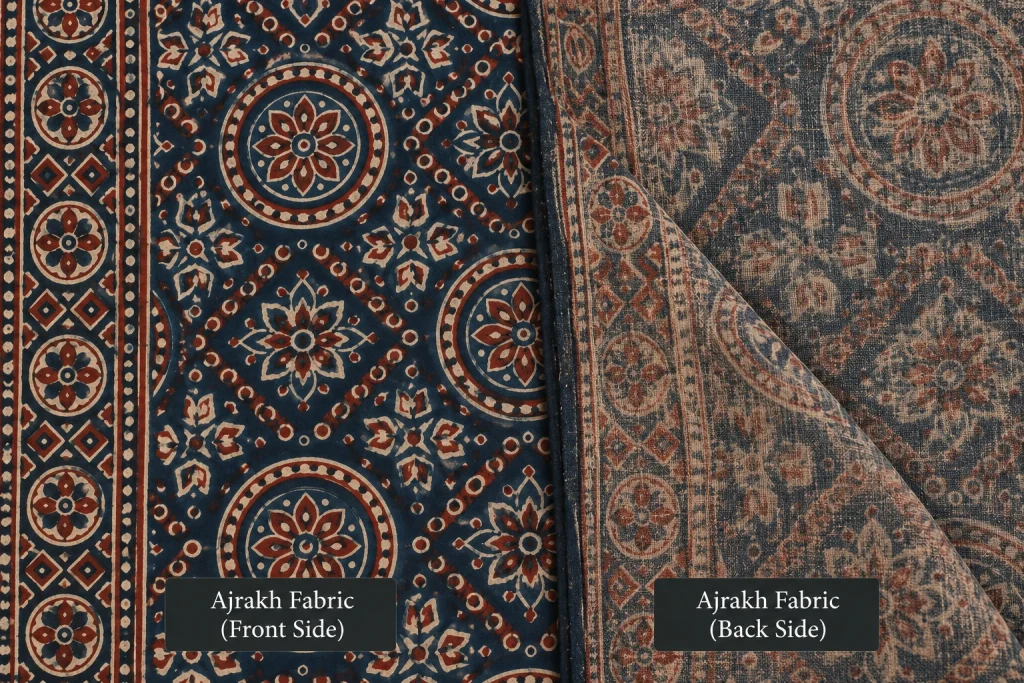
1. Turn the fabric over. If the pattern is as strong on the back as the front, you are almost certainly holding Ajrakh. Bagru is printed on one side; the reverse shows a faded impression.
2. Look at the background. A warm cream or beige ground points to Bagru. A ground saturated in indigo or deep red points to Ajrakh.
3. Read the motifs. Flowers, leaves, vines and birds are Bagru. Stars, medallions and interlocking geometry are Ajrakh.
4. Count the colours. Bagru commonly works in two or three — black and red on cream, or indigo and white. Ajrakh layers indigo, madder, black and white on one cloth.
5. Check the density. Bagru leaves the ground visible between motifs. Ajrakh tends to fill the field.
None of these is absolute. Contemporary printers borrow from each other, and you will find Ajrakh-style geometry printed in Bagru and floral Ajrakh from Kutch. Treat them as a guide, not a test.
What They Have in Common
Both are natural dye block printing traditions. Both use hand-carved wooden blocks rather than screens or machines. Both build colour in layers, with a separate block for each one.
And both carry the same honest irregularities. A faint join where two impressions meet. One motif slightly deeper than its neighbour. A shift in colour along a length. These are the marks of the hand, and they are how you distinguish either craft from a machine-printed imitation. A digital print is flawlessly uniform, and it looks it.
Which Should You Choose?
Choose Bagru for everyday wear. The lighter ground and open motifs suit office days, summer, and sarees you want to reach for without thinking. A Bagru print saree in mul cotton is about as easy as a saree gets.
Choose Ajrakh when you want depth and presence. The dense geometry and saturated colour carry well into evenings, festivals and occasions where you want the cloth to do the talking. An Ajrakh print saree on a fluid base like modal silk is striking — see our Ajrakh and Vanaspati Ajrakh pure modal silk sarees.
A note on terminology you will meet while shopping: Vanaspati Ajrakh refers to Ajrakh printed with plant-based dyes, as distinct from pieces using other dye systems. Worth knowing, because sellers are not always specific about it.
Frequently Asked Questions
Is Ajrakh a type of Bagru print?
No. They are separate traditions from different regions, practised by different communities. Both are forms of hand block printing, which is why they are often confused, but neither is a subset of the other.
Which is more expensive, Bagru or Ajrakh?
Ajrakh print fabric is usually costlier. The double-sided printing and the long sequence of dyeing and washing stages mean far more labour goes into each metre of cloth.
Is Ajrakh print always double-sided?
Traditional Ajrakh is printed on both sides with the faces aligned. Some contemporary production prints one side only, so check the reverse if double-sided work matters to you.
What colours are used in Bagru print?
Traditionally black and red on a cream or beige ground created by a harda treatment, with indigo used widely as well. Black comes from a fermented iron solution and red from alum-based mordants.
Is Dabu the same as Bagru?
Dabu is a mud-resist technique closely associated with the Bagru area, so the two overlap but are not identical. Bagru refers to the printing tradition of the region; Dabu refers to one specific resist method used within it.
Can you wash Ajrakh and Bagru fabrics the same way?
Broadly yes. Hand wash separately in cold water with a mild detergent, dry in shade, and expect some colour release in the first two or three washes. Our saree care guide covers this in detail.
Where to See Both
We print Bagru at our own unit in Bagru, Rajasthan, and stock Ajrakh printed pieces alongside it. Browse our hand block printed sarees to compare the two in person, or read our longer guide to what Bagru printing is and how to identify an authentic hand block print.
One Comment