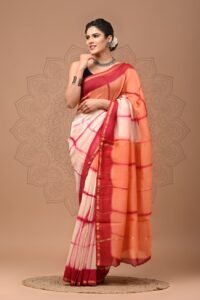
Bagru Printing: History, Process & How to Identify Authentic Hand Block Print
Bagru printing is a hand block textile printing tradition from the town of Bagru, Rajasthan, practiced primarily by the Chhipa (also spelled Chippa) community. It’s one of two hand block printing crafts from the Jaipur region — the other being Sanganeri printing — that hold official Geographical Indication (GI) status in India, recognizing them as regionally distinct traditional crafts.
If you’ve searched for what Bagru printing actually is, how it’s made, or how to tell an authentic piece from a mass-produced imitation, this guide covers all three — grounded in what’s actually documented about the craft, not marketing language dressed up as history.
What Is Bagru Printing?
Bagru printing is a direct hand block printing technique: a hand-carved wooden block is dipped in dye or printing paste and pressed onto fabric, repeated across the cloth to build a pattern. It’s distinct from resist techniques like Dabu (covered in detail below), where a paste blocks dye from reaching parts of the fabric rather than applying color directly.
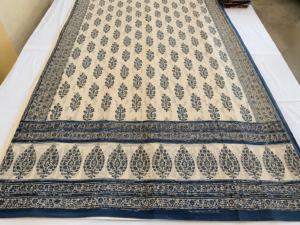
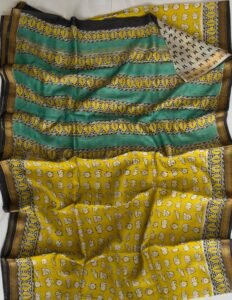
The craft is named for its place of origin — the town of Bagru, located roughly 30 km west of Jaipur, Rajasthan. Traditionally, Bagru prints were used on garments such as ghagras (skirts), odhnis (veils/dupattas), sarees, and turbans (pagdis), as well as household textiles like bedspreads, cushion covers, and razais (quilts). Today, the same techniques are applied to a much wider range of fabric and finished products for both domestic and international markets. Our Bagru hand block printed cotton sarees.
Where Did Bagru Printing Originate?
Bagru printing originated in and takes its name from the town of Bagru in Rajasthan’s Jaipur district. According to the Development Commissioner (Handicrafts), Government of India, the craft is practiced primarily by the Chhipa community, and the town’s location near the Sanjariya river and its clay-rich local soil made it well suited to the repeated washing and drying steps the traditional printing and dyeing process requires.
Bagru sits within a wider regional cluster of Rajasthani hand block printing traditions — Sanganeri printing (from nearby Sanganer) is the most commonly compared, and Dabu resist printing is practiced both in and around Bagru and in other parts of Rajasthan. These are related crafts that share tools and community history but are not identical to one another — see the comparison sections below.
A Brief History of Bagru Printing
Sources describing the craft’s age vary — some cite roughly 350 years of continuous practice, others describe it as over 400 years old. Rather than treat either figure as precise, it’s more accurate to say Bagru printing is a long-established, multi-generational craft tradition whose exact founding date isn’t consistently documented across sources. (If you need a specific figure for publication, the Development Commissioner Handicrafts craft documentation or regional museum/academic sources should be checked directly — see the fact-check section at the end of this article.)
What is well documented: Bagru Hand Block Print received Geographical Indication (GI) registration in India, formally recognizing it as a craft whose distinctive character is tied to its specific place of origin. Published sources give differing years for this registration (some citing 2003, others 2010–2011), so the exact date should be confirmed against the official GI Registry before being stated as fact in any published material.
Like many regional handicrafts, Bagru’s textile production has changed over time. The Development Commissioner’s own craft documentation notes that while traditional practice used natural dyes and fully manual processes, some workshops in and around Bagru today also use screen printing and chemical/synthetic dyes to meet larger-scale commercial demand. This means not everything sold under the “Bagru print” name today is produced using the traditional hand block method — a distinction covered further in the Misconceptions section below.
How Is Bagru Hand Block Printing Done?
The exact process varies by workshop, by the specific technique used (direct printing vs. Dabu resist), by the dyes involved, and by the fabric. The stages below describe the traditional direct block printing process in general terms — not a single universal procedure that applies identically to every Bagru textile.
Preparing the Fabric
Raw fabric is typically washed to remove starch, sizing, and impurities before printing, since these can interfere with dye absorption. Depending on the fabric and intended dye, it may also be treated with a mordant (a substance that helps dye bind to fiber) at this stage.
Carving and Preparing Wooden Blocks
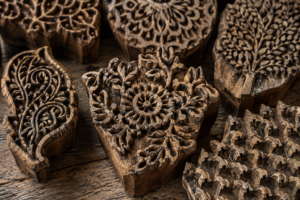
Printing blocks are hand-carved from wood (traditionally woods such as teak or sheesham are referenced in craft documentation) by specialist block carvers. Each block carries part of a motif — a single design often requires multiple blocks for outline and for each additional color, aligned precisely during printing.
Preparing the Printing Paste or Dye
For direct printing, dye or printing paste is prepared according to the desired color. Traditional Bagru work is closely associated with natural dye sources — for example, indigo for blue tones and madder-root-based dyes for red tones are referenced in craft literature — though synthetic/chemical dyes are also used in the wider market today (see Misconceptions below for why this distinction matters).
Printing the Fabric
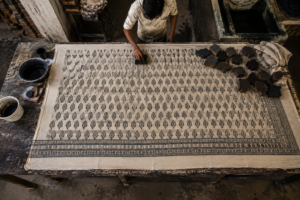
The fabric is laid flat on a padded printing table. The artisan dips the carved block into the dye or paste and presses it firmly onto the cloth by hand, applying even pressure to transfer a clean impression. Bagru printed linen cotton sarees.
Repeating Colours and Motifs
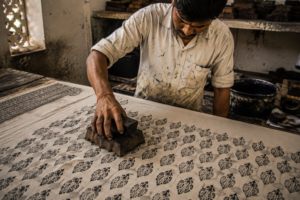
The block is repositioned and pressed again, repeated across the length of the fabric to build the full pattern. Where a design uses multiple colors, a separate block is used for each color, printed in careful alignment (registration) with the previous layer.
Washing, Drying and Finishing
Printed fabric is dried, and depending on the dyes and technique used, may go through further washing, dye-fixing, or finishing steps before it’s ready for use. For resist techniques like Dabu (below), a washing step is essential to the process itself, not just a finishing step — it’s what reveals the final pattern.
What Makes Bagru Hand Block Printing Different?
Compared to some other regional printing traditions, Bagru work is generally associated with:
- Bolder, more geometric motifs — interlocking grids, waves, dotted patterns, and abstracted florals, rather than the finer, more delicate floral detailing associated with Sanganeri work
- Deeper, earthier background tones — indigo blue, madder red, and warm cream/off-white grounds are commonly cited as characteristic, rather than the crisp white backgrounds associated with Sanganeri printing
- A close relationship with resist (Dabu) printing — direct block printing and Dabu resist work are both practiced in the Bagru area, and pieces described as “Bagru print” in the market may use either technique, or a combination
Bagru Direct Printing vs Dabu Printing
These two techniques are closely associated with the same region and community, but they work differently and are not the same thing. Treating “Bagru print” and “Dabu print” as interchangeable is one of the most common inaccuracies in casual descriptions of this craft.
| Bagru Direct Printing | Dabu (Mud-Resist) Printing | |
|---|---|---|
| Basic process | Dye or printing paste is applied directly to the fabric via the carved block | A mud-based resist paste is applied via the carved block before dyeing; the dyed color doesn’t penetrate the resisted areas |
| Role of the block | Transfers color/pattern directly | Transfers the resist paste, not color |
| Resist material | Not used | A paste typically made from mud/clay, lime, gum, and materials such as wheat chaff (recipes vary by workshop) |
| Colour application | Direct, at the printing stage | Indirect — color comes from a dye bath applied after the resist is printed and dried |
| Finished appearance | Motif appears in the printed color against the base fabric | Motif appears as the original (undyed) fabric colour against a dyed background, often with fine textured “veining” where the resist naturally cracked during drying |
| A defining visual trait | Crisper block outlines | Slightly irregular, organic edges where the resist paste didn’t form a perfectly uniform barrier — this is a natural feature of the process, not a flaw |
Both techniques are traditionally practiced by artisans in and around Bagru, and a single finished textile may combine both — for instance, a resist-printed motif on a piece that also carries direct block-printed color elsewhere.
How to Identify Authentic Bagru Hand Block Printing
This is the section most shoppers actually want, so it’s worth being precise about what genuinely helps — and what doesn’t.
Physical characteristics commonly associated with genuine hand block printing:
- Slight variations in print placement from one motif repeat to the next — hand-pressed blocks won’t align with perfect machine precision every time
- Minor differences in colour intensity across a single piece, especially with natural or hand-mixed dyes
- Small registration/alignment variations where multiple colors overlap
- A tactile, slightly raised texture where paste/dye sits on the fabric surface, more noticeable on some techniques than others
- With Dabu specifically, fine cracked “veining” in the resisted areas, from natural cracks in the drying mud paste
Why these signs alone aren’t proof of authenticity: modern printing methods, including some screen-printing processes, can deliberately imitate an irregular, “hand-printed” look precisely because shoppers look for it. A single small irregularity on a photo or in person doesn’t reliably distinguish a hand-printed piece from a machine-printed one designed to mimic that appearance. Treating “it has slight imperfections” as sufficient proof on its own is a common but unreliable shortcut.
What actually helps assess authenticity, more reliably than visual inspection alone:
- Seller transparency — does the seller clearly state the printing method (hand block vs. screen print vs. digital print) for the specific piece, not just generic brand-level claims?
- Production information — can the seller describe, even briefly, where and how the piece was made?
- Fabric information — is the fabric composition clearly stated, and does it match what’s plausible for the technique described?
- Product-level description, not just brand-level marketing — a trustworthy listing describes that specific product’s technique and materials, not just a general “handmade in Rajasthan” tagline applied to an entire catalog
- Provenance where available — any concrete detail about the workshop, region, or artisans involved, when a seller is able to share it genuinely
- Trustworthy sourcing overall — a seller’s general transparency and consistency across their catalog is a better signal than any single visual cue on one product
Common Misconceptions About Bagru Printing
“All Bagru print is hand block printed.” Not necessarily. As the Development Commissioner Handicrafts documentation itself notes, some workshops in the Bagru market now use screen printing and chemical dyes to meet larger commercial demand. “Bagru print” as a market term is broader than the traditional hand block technique it originated from.
“Bagru and Dabu are the same thing.” They’re related and often practiced by the same communities, but Dabu is specifically a resist technique, while Bagru direct printing applies color directly. See the comparison table above.
“Natural dyes and chemical-free processes are guaranteed.” Traditional Bagru work is historically associated with natural dye sources, but this isn’t automatically true of every piece sold as “Bagru print” today — some use synthetic/chemical dyes, which can still involve genuine hand block application. Whether a specific piece uses natural or synthetic dye is a claim that should be stated explicitly by the seller for that product, not assumed from the craft’s general reputation.
“Any small flaw proves it’s handmade.” As covered above, this isn’t a reliable test on its own — some reproductions are made specifically to mimic this look.
“Bagru and Sanganeri are basically the same craft.” They’re both Jaipur-region hand block printing traditions with shared history, but they differ meaningfully in technique, motif style, and typical colour palette — see below.
Bagru Printing vs Other Rajasthan Block Printing Traditions
Sanganeri printing, from the nearby town of Sanganer, is the tradition most often compared to Bagru. Both hold GI status and share a broadly similar toolkit — hand-carved wooden blocks, similar categories of dye — but differ in some consistently cited respects:
| Bagru Printing | Sanganeri Printing | |
|---|---|---|
| Typical background | Darker, dyed grounds — indigo, madder red, warm cream tones are commonly cited | Predominantly white or off-white background |
| Typical motif style | Bolder, more geometric — grids, waves, dotted patterns, abstracted florals | Finer, more delicate floral and botanical detail; intricate, often multi-colour layered motifs |
| Technique emphasis | Strong association with resist (Dabu) work alongside direct printing | Predominantly direct block printing |
| General character | Earthier, more rustic | More refined, detailed |
This is a general comparison, not an absolute rule — individual workshops and pieces vary, and the two traditions have influenced each other over their shared regional history. Neither tradition is objectively “better”; they’re distinct aesthetic and technical approaches from the same broader region.
Why Small Variations Can Occur in Hand Block Printed Fabric
Because each impression is applied by hand rather than by a fixed machine registration system, some natural variation between one printed unit and the next — or even within a single length of fabric — is an inherent feature of the process, not a manufacturing defect. This includes slight shifts in motif spacing, small differences in pressure (affecting how much dye/paste transfers), and natural variation in dye uptake, especially with natural dyes that can respond differently to small changes in water, temperature, or fabric batch.
This is worth understanding both as a shopper (so you know what to expect from a genuinely hand-printed piece) and as a seller (so this can be explained honestly rather than either hidden or oversold as proof of authenticity on its own).
Frequently Asked Questions
Is Bagru printing done entirely by hand? Traditional Bagru direct printing and Dabu resist printing are both hand-applied, block by block. However, as noted above, not every product marketed as “Bagru print” today uses this traditional hand method — some workshops use screen printing or other mechanized methods. Check the specific product description rather than assuming from the craft name alone.
What blocks are used in Bagru printing? Hand-carved wooden printing blocks, prepared by specialist block carvers. Each design typically requires a separate block for the outline and for each additional colour used.
What dyes are used in Bagru printing? Traditional practice is associated with natural dye sources — indigo for blue, madder-root-based dyes for red, among others referenced in craft literature. Synthetic/chemical dyes are also used in the broader modern market. The dye type used in any specific product should be confirmed with the seller rather than assumed.
What’s the difference between Bagru and Dabu printing? Bagru direct printing applies colour to the fabric directly via the block. Dabu is a resist technique — the block applies a mud-based paste that blocks dye from reaching certain areas, and the pattern is revealed once the resist is washed away after dyeing. See the full comparison table above.
What’s the difference between Bagru and Sanganeri printing? Both are GI-registered Jaipur-region hand block printing traditions, but they differ in typical background colour (Bagru: darker/dyed grounds; Sanganeri: white/off-white), motif style (Bagru: bolder and more geometric; Sanganeri: finer and more floral), and technique emphasis (Bagru: closely tied to Dabu resist work; Sanganeri: predominantly direct printing).
How can I identify authentic Bagru hand block printing? Look for natural print-placement and colour variation as a positive sign, but don’t rely on this alone — pair it with seller transparency about the actual printing method, fabric, and production details for that specific product. See the full section above for a complete list of what to check.
Conclusion
Bagru printing is a genuine, GI-recognized regional craft with a long documented history in and around its namesake town — but the term covers more ground in today’s market than the traditional hand block method alone, and it’s closely related to, but distinct from, both Dabu resist printing and neighbouring Sanganeri printing. Understanding these distinctions is the difference between buying (or selling) with real knowledge of the craft, and repeating marketing language that blurs several different things into one romantic story. Bagru printed suits.