What Is Ajrakh Print? Meaning, Process & Authenticity Guide
Ajrakh is a traditional resist-and-mordant block-printing craft historically associated with Sindh and with Kutch in Gujarat, with production also in Barmer in Rajasthan. It is known for dense geometric repeats and a palette built on indigo blue, madder red, iron black and the undyed white of the cloth.
Where we stand, before anything else. We are Bagru printers. Ajrakh is not a Bagru craft and we don’t claim it as one — it belongs to Kutch, to Sindh, and to the Khatri families who have made it for centuries. Our Ajrakh and Vanaspati Ajrakh sarees are hand block printed for us by artisan units here in Bagru, on cloth we buy and prepare, to designs and colourways we choose. They are Ajrakh printed in Bagru, not Ajrakh from Kutch, and those are different things. This guide explains the difference properly, because you should be able to tell them apart — including when you’re looking at ours.
What Is Ajrakh Print?
Ajrakh print is a resist-dyed block printing tradition built on natural dyes — deep indigo, madder red, iron black, and the undyed white of the cloth itself. What separates an Ajrakh hand block print from other block printing is not the motifs but the process: layer upon layer of resist paste, mordant and dye, applied in sequence, with the cloth washed and dried between each stage.
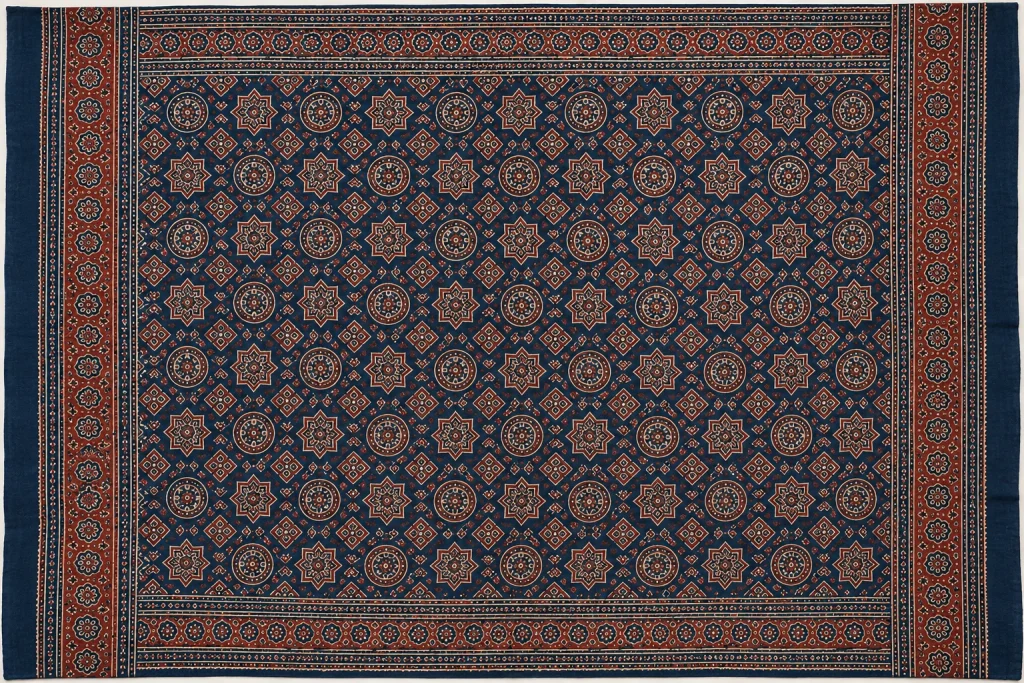
The result is a fabric where the colour sits inside the weave rather than on top of it. Hold an Ajrakh print fabric to the light and the pattern has depth that a surface print cannot imitate.
Ajrakh Meaning
Two explanations circulate, and both are plausible.
The first traces the word to azrak, Arabic and Persian for blue — a reference to the indigo that dominates the palette. The second traces it to aaj rakh, or aaj ke din rakh, meaning “keep it today” — a nod to the patience the craft demands while cloth rests between stages.
Printers in Kutch tell both stories. Neither has been settled.
Where Ajrakh Comes From
Ajrakh in Kutch is associated with the Khatri community, who migrated from Sindh into Kutch in Gujarat and Marwar in Rajasthan. Accounts place this around the sixteenth century, when the ruler of Kutch invited the printers to settle. They chose sites along running water, because Ajrakh cannot be made without it — every stage requires washing.
Fragments of printed cloth recovered from Mohenjo-daro bear patterns resembling Ajrakh, which is why the craft is often described as several thousand years old. The claim is widely repeated; treat it as likely rather than proven.
Today Ajrakh is printed in Ajrakhpur and Dhamadka in Kutch, in Barmer in Rajasthan, and in Sindh in Pakistan. Ajrakhpur itself is recent — the village was founded after the 2001 Kutch earthquake displaced artisan families from Dhamadka.
Alongside that traditional production, Ajrakh’s motif language and much of its method have travelled to other printing centres, Bagru among them. That is where our own sarees are made, and we come back to what it means further down.
How Ajrakh Is Made
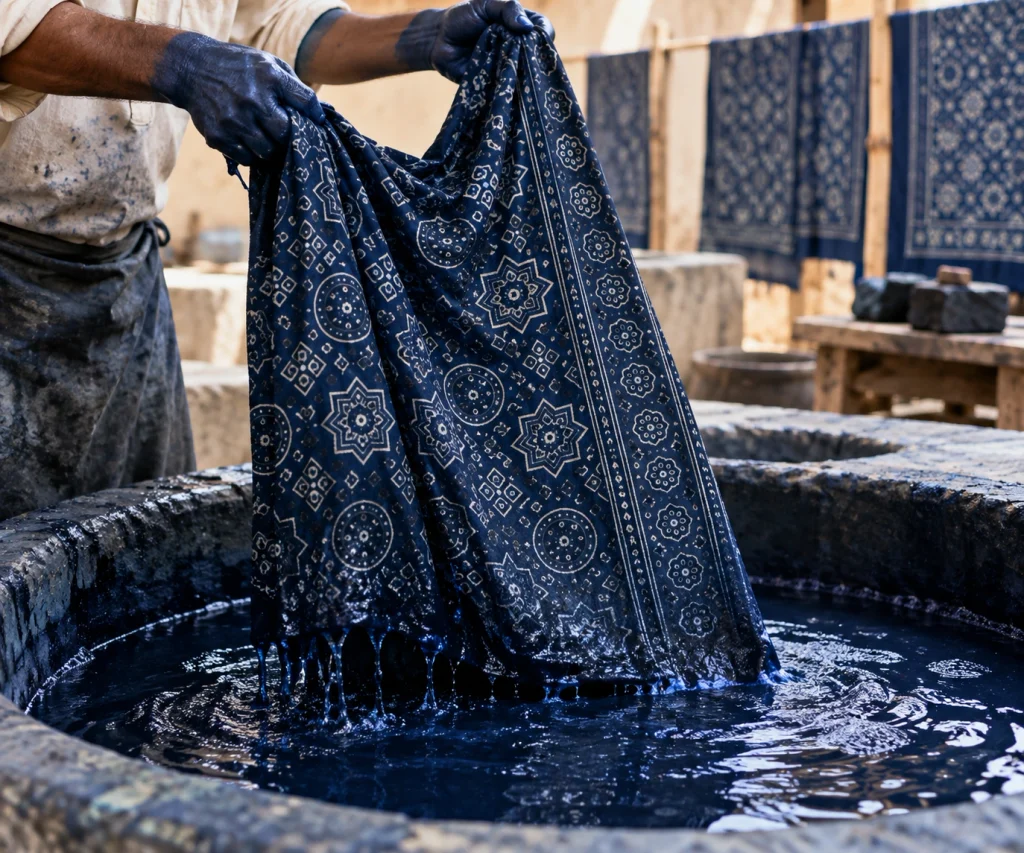
The sequence varies between workshops, but the shape of it is consistent.
Traditional Ajrakh is commonly described as a sixteen-stage process, though workshops differ and the count depends on how you group the steps. Start to finish it runs roughly two to three weeks, most of it spent washing and drying rather than printing.
Saaj. The cloth is washed, beaten and soaked in a preparation that traditionally includes camel dung, soda and castor oil. It is left to age for several days. Printers describe the resulting smell as close to mango pickle, and they treat it as the sign the cloth is ready.
Kasanu. A treatment with harda, or myrobalan, which lends a yellow tinge and helps the fibres take up dye.
Resist and mordant printing. Blocks lay down the areas that will become black, using an iron-based mordant, and the areas to be protected from dye, using kharrh — a resist paste of gum, rice paste, alum and lime.
Indigo. The cloth enters a vat fermented in clay vessels over several weeks. Unprotected areas take the blue; resisted areas stay pale.
Madder. Boiling with alizarin and tamarix flower brings up the red.
Washing, drying, repeating. Between every stage the cloth is washed and sun-dried. This is most of the fourteen to twenty-one days.
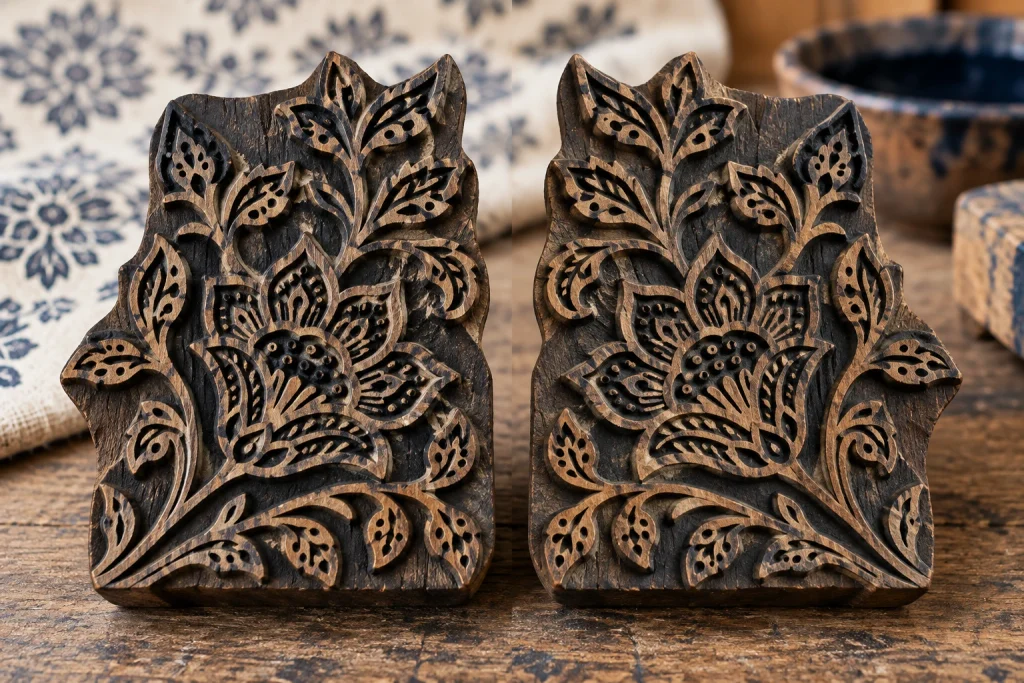
Because the blocks are carved in mirrored pairs, the same design can be registered on the reverse — which is how traditional Ajrakh achieves its double-sided finish.
One note on dyes, since the word gets used loosely
Traditional Ajrakh red comes from madder root. Much modern production uses alizarin, which was originally extracted from madder but is now manufactured synthetically. Both are sold as Ajrakh. Neither is a fraud, but they are not the same thing, and a seller who can’t tell you which one they used probably doesn’t know.
This matters for the term Vanaspati Ajrakh, which is used inconsistently across the trade. Some sellers use it to mean plant-based or vegetable dyes. Others use it to distinguish alizarin and chemical-dyed Ajrakh from fully natural work. Because it can mean either, the word on its own tells you very little — ask what the dye actually was.
Ajrakh Motifs
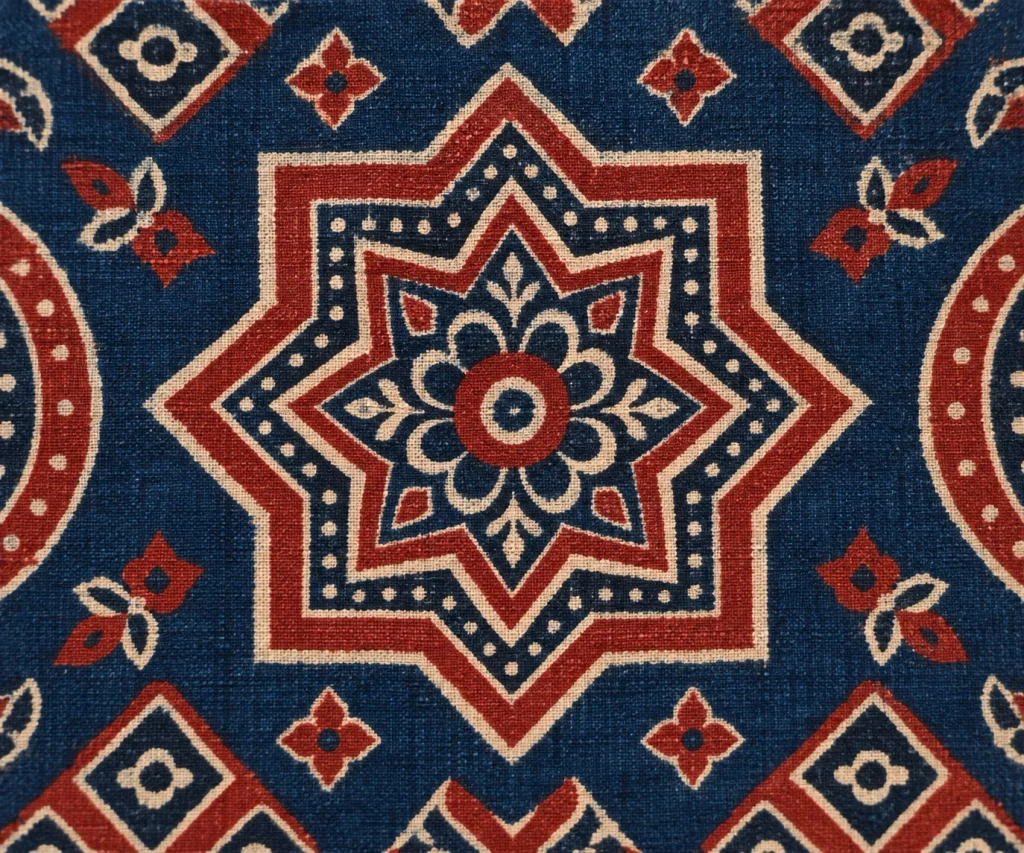
Ajrakh motifs are geometric and mathematical rather than pictorial. Eight-pointed stars, interlocking medallions, trefoil and clover forms, fine repeating borders that frame the field. Patterns are built on grids and symmetry, closer to architectural ornament than to the flowers and birds of Rajasthani printing. An Ajrakh block print reads as structure first, decoration second.
The palette does much of the work: indigo blue and madder red set against black and white, often all on one cloth.
How to Identify Authentic Ajrakh
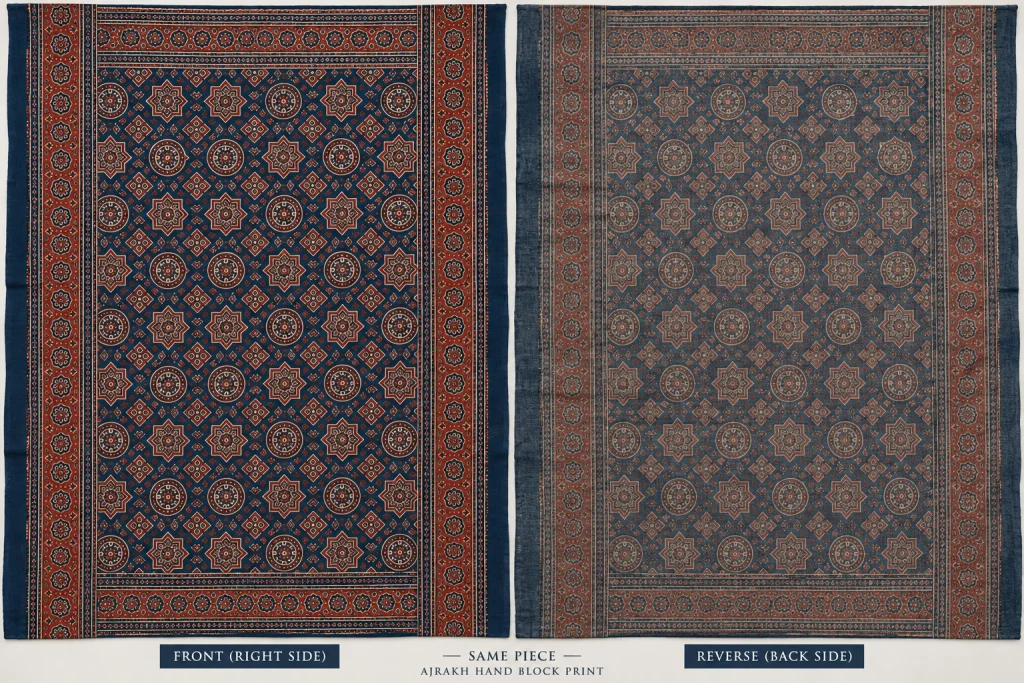
Turn it over. Traditional Ajrakh is printed on both sides with the faces aligned. A strong, matching reverse is the clearest single indicator.
Look for irregularity. Faint joins where impressions meet, a motif marginally deeper than its neighbour, slight colour drift along the length. Machine prints have none of this.
Smell it. Freshly made natural-dye Ajrakh carries a faint earthy, mineral scent from the mordants. Synthetic imitations smell chemical. Not reliable on older cloth, but useful at a market stall.
Ask where it was made. Sellers of genuine Ajrakh can name the village — Ajrakhpur, Dhamadka, Barmer — and often the printer.
Check the dye description. Vanaspati Ajrakh means Ajrakh printed with plant-based dyes. Where a seller is vague about the dye system, ask.
Ajrakh Sarees and What to Look For
An ajrakh print saree behaves differently depending on the base cloth.
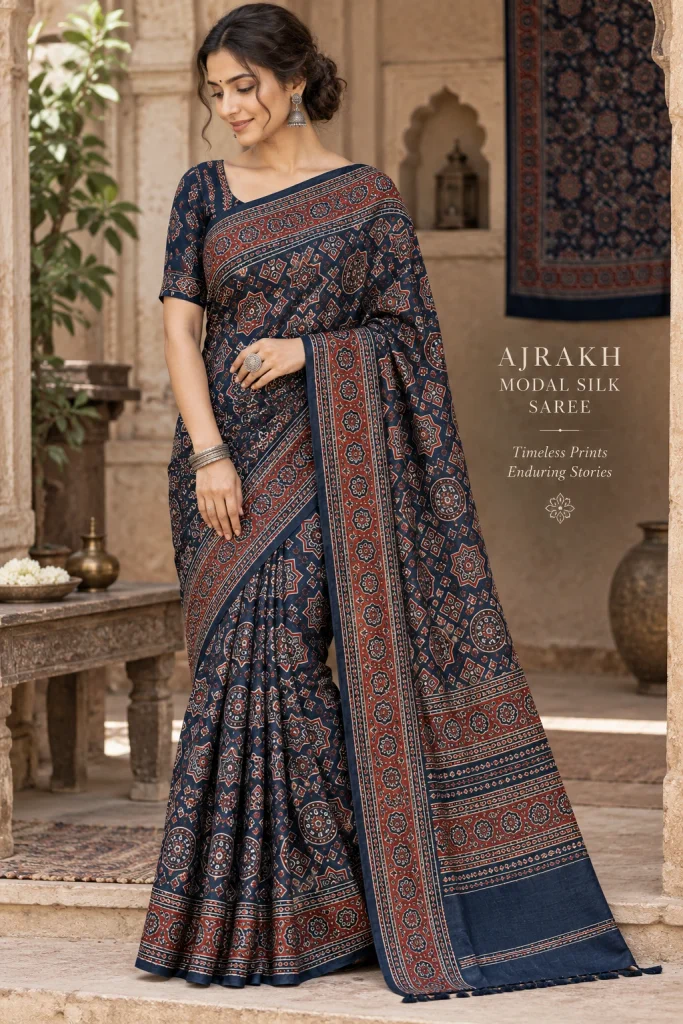
Modal silk has become the most popular base, and it suits the print well — modal is fluid and takes deep colour, so an ajrakh modal silk saree holds indigo and madder with real saturation while draping softly. Our Ajrakh and Vanaspati Ajrakh pure modal silk sarees are printed on this base.
Cotton gives a crisper, more traditional result, closer to how Ajrakh was historically worn. An ajrakh cotton saree is the better choice for daily wear and hot weather.
Silk takes the dye with more sheen and suits occasion wear, though an ajrakh silk saree usually costs more and asks for more careful washing.
Ajrakh also appears as an ajrakh dupatta, unstitched dress material, kurtas and suit sets. The same identification checks apply to all of them.
Caring for Ajrakh
Hand wash separately in cold water with a mild detergent. Do not soak for long, scrub or wring. Dry in shade, never direct sun — natural dyes fade in strong light. Iron on medium heat from the reverse.
Expect some colour release in the first two or three washes. With indigo especially, this is the dye settling rather than the print failing.
Ajrakh and Bagru Are Not the Same Craft
They’re confused constantly, and they’re different traditions.
Bagru is Rajasthani, printed by Chhipa families on a cream ground created with harda, carrying floral buti, bel vines and jaal lattice, printed on one side. Ajrakh is from Sindh and Kutch, printed by Khatri families in saturated indigo and madder, geometric, printed on both sides.
Both use hand-carved blocks. Both use natural dyes. Beyond that they share little — which is why “Ajrakh printed in Bagru” is a fair description of a real product and a poor description of a Kutch heirloom.
We’ve written a fuller comparison in Bagru print vs Ajrakh print, and a full account of the craft we practise ourselves in what Bagru printing is and how to identify an authentic hand block print.
Frequently Asked Questions
What does ajrakh mean?
Two derivations are offered. One traces it to azrak, Arabic and Persian for blue, after the indigo central to the craft. The other traces it to aaj rakh, meaning “keep it today”, referring to the patience the process demands. Both are commonly cited.
Is ajrakh print natural dye?
Traditional Ajrakh uses natural dyes — indigo for blue, madder and alizarin for red, iron-based mordants for black. Not everything sold as Ajrakh today is naturally dyed, so check with the seller. Vanaspati Ajrakh specifically indicates plant-based dyes.
Why is ajrakh expensive?
Fourteen to sixteen stages of printing, dyeing, washing and drying, spread over two to three weeks, with the pattern printed on both sides of the cloth. The cost reflects labour and time rather than materials.
Is ajrakh printed on both sides?
Traditional Ajrakh is, with the blocks carved in mirrored pairs so the reverse registers an exact inverted image. Some contemporary production prints one side only. Check the reverse.
What is vanaspati ajrakh?
Ajrakh printed using plant-based dyes. The term distinguishes it from pieces produced with other dye systems.
Where is ajrakh made?
Principally in Ajrakhpur and Dhamadka in Kutch, Gujarat, with production also in Barmer in Rajasthan and in Sindh in Pakistan.
Which is better for daily wear, ajrakh cotton or modal silk?
Cotton is more breathable and easier to wash, so it suits daily wear. Modal silk drapes more softly and holds colour more deeply, which suits occasions.
See Ajrakh in Person
Browse our Ajrakh modal silk sarees, or see the full range of hand block printed sarees to compare Ajrakh against the Bagru, Dabu and Shibori work we print ourselves. For the craft we do practise, read what Bagru printing is and how to identify an authentic hand block print.